

The morning sun filters through the blinds, casting striped shadows on the cluttered desk. A cold cup of coffee sits forgotten next to a keyboard, its keys worn from frantic typing. The phone buzzes—another email, another notification, another demand. A tightness coils in the chest, a familiar hum in the back of the mind. Is this stress? Or has it tipped over into something else, something more pervasive called anxiety? In our hyper-connected, achievement-oriented world, these two states have become the background noise of modern life, often used interchangeably. Yet, understanding their distinct contours is not an academic exercise; it is the first, crucial step toward reclaiming a sense of agency and well-being.
The Physiology of Pressure vs. The Psychology of Apprehension
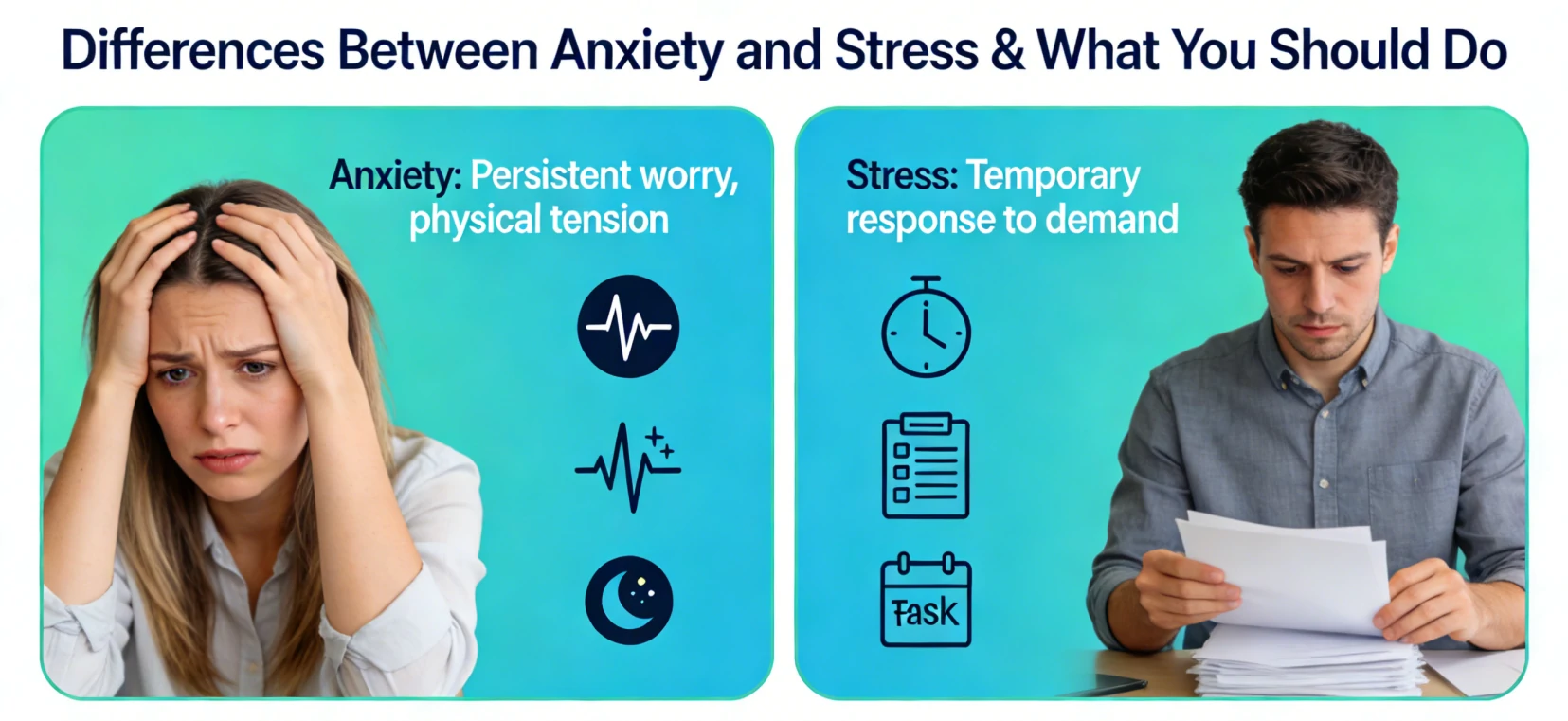
Let’s begin by untangling the biological and psychological threads. Stress, in its essence, is a response to an external pressure or demand—a deadline, a financial obligation, a conflict. It’s the body’s ancient, hardwired alarm system, often called the "fight-or-flight" response. When your boss assigns a high-stakes project due tomorrow, your hypothalamus signals your adrenal glands to release a cascade of hormones, chiefly cortisol and adrenaline. Your heart pounds, muscles tense, senses sharpen. This is stress. It’s a reaction to a real and present challenge. As Dr. Emily Nagoski, co-author of Burnout, explains, "Stress is the neurological and physiological shift that happens in your body when you encounter a challenge." It has a clear, identifiable trigger and, ideally, a resolution. Once the project is submitted, the presentation is over, the bill is paid, the physiological arousal subsides.
Anxiety, however, is different. It is stress’s more insidious cousin. If stress is a reaction to a current, external "something," anxiety is often a reaction to the anticipation of a future "something"—or even a nebulous, unidentified threat. It’s the body’s alarm system misfiring, ringing incessantly long after the fire is out, or when there was never a fire to begin with. The physiological symptoms can be identical—racing heart, sweating, tension—but the catalyst is internal: a pattern of persistent, excessive worry. The American Psychological Association defines anxiety as "an emotion characterized by feelings of tension, worried thoughts, and physical changes like increased blood pressure." The key is the "worried thoughts" that persist in the absence of, or disproportionate to, an immediate external stressor. You might feel intense anxiety about the project’s reception weeks after submitting it, or about a social event that’s months away. The trigger is often vague, and the feeling lingers, creating a state of sustained high alert.
A helpful, though imperfect, analogy is this: Stress is the feeling you get when you’re being chased by a bear. Anxiety is the feeling you get when you worry you might encounter a bear on every future hike, even in a city park.
The Spectrum of Experience: From Functional to Debilitating
Recognizing the difference is vital because they operate on a spectrum with vastly different implications for our lives. Stress, in moderate doses, is not only normal but functional. This concept, known as eustress (positive stress), is the force that helps us meet deadlines, excel in competitions, and navigate complex problems. It provides focus and energy. The problem arises with chronic stress—when the demands consistently outpace our resources for coping, and the "fight-or-flight" button is stuck in the "on" position. This can lead to burnout, a state of emotional, physical, and mental exhaustion characterized by cynicism, inefficacy, and depletion.
Anxiety exists on its own problematic spectrum. Everyday worry about real-life problems is normal. But when the worry becomes excessive, uncontrollable, and interferes with daily functioning, it may cross into the territory of an anxiety disorder, such as Generalized Anxiety Disorder (GAD). According to the World Health Organization, anxiety disorders are among the most common mental health conditions globally, affecting an estimated 301 million people in 2019. The line between adaptive concern and a clinical condition is often drawn at the point of impairment. Does the worry prevent you from concentrating at work, socializing with friends, or falling asleep night after night?
Consider two individuals facing a corporate restructuring. Alex feels significant stress: working longer hours to prove their value, feeling irritable, having trouble sleeping as they strategize for the future. The trigger (the restructuring) is clear, and Alex’s reactions, while uncomfortable, are tied directly to navigating this real-world challenge. Sam, on the other hand, is consumed by anxiety. Sam lies awake not just planning, but catastrophizing: "What if I’m the first to be laid off? What if I can’t find another job? What if this ruins my career and I end up losing my house?" The initial stressor has spawned a web of "what-ifs" that play on a loop, creating a paralyzing dread that exists far beyond the concrete realities of the situation. Sam might start avoiding meetings with management or calling in sick, behaviors that ironically increase the actual risk they fear.
The Modern Catalysts: Why Now Feels Different
Our contemporary environment acts as a potent accelerant for both states, but in ways that uniquely blur their lines. The 24/7 digital tether means work stress invades our homes, and global crises flicker on our screens, making threats feel omnipresent and personal. Social media, as some researchers argue, creates a "compare and despair" dynamic, fueling anxiety about our status, appearance, and life progress. The economist and social theorist William Davies, in his book The Happiness Industry, posits that the constant measurement and optimization of the self in the digital age can turn life into a source of perpetual performance anxiety.
Furthermore, the nature of work has evolved. The rise of the "gig economy" and knowledge work has replaced clear physical boundaries with amorphous psychological ones. Stressors are less about immediate physical danger and more about cognitive overload, email avalanches, and the pressure of constant availability. This can make the source of our discomfort feel vague and internal, morphing stress into anxiety. A 2022 study published in the Journal of Occupational Health Psychology found that "telepressure"—the urge to quickly respond to work-related messages—was significantly linked to both higher stress and burnout, as well as increased symptoms of anxiety and poor sleep quality. The external trigger (a message notification) instantly becomes an internal state of anxious obligation.
Navigating the Terrain: Practical Strategies for Each
Understanding the distinction is only half the battle. The other half is knowing what to do. The management strategies for stress and anxiety, while overlapping, have different points of emphasis.
For Stress: Manage the Demand and Replenish Resources Since stress is often a response to an external load, the solutions are frequently external and action-oriented.
For Anxiety: Manage the Mind and Tolerate Uncertainty Since anxiety is fueled by internal worry about the future, strategies focus on the relationship with your own thoughts.
The Overlap and the Path Forward
Of course, the human experience is rarely neat. Chronic stress can undoubtedly trigger or exacerbate anxiety disorders. And living with an anxiety disorder makes one far more vulnerable to experiencing everyday stressors as overwhelming threats. They exist in a feedback loop.
The ultimate goal is not the impossible eradication of stress or worry, but the cultivation of what psychologists call stress resilience and anxiety tolerance. It’s about building a life and a mindset where pressure can be met with focused energy rather than panic, and where uncertainty can be acknowledged without spiraling into dread.
It begins with the simple, powerful act of naming. The next time that tightness coils in your chest, pause. Ask yourself: "Is this a bear chasing me right now, or am I worrying about bears in the future?" The answer won’t make the feeling vanish, but it will illuminate the path forward—whether it leads toward actionable problem-solving or mindful acceptance. In a world that constantly pushes us toward more, the real skill may be in discerning what we are truly facing, and responding not with a blanket reaction, but with a chosen, humane response. Our well-being may depend on this quiet, internal taxonomy of our own discomfort.